First published on October 22, 2026 · Updated on November 6, 2026 · Data window 11 October–6 November 2026
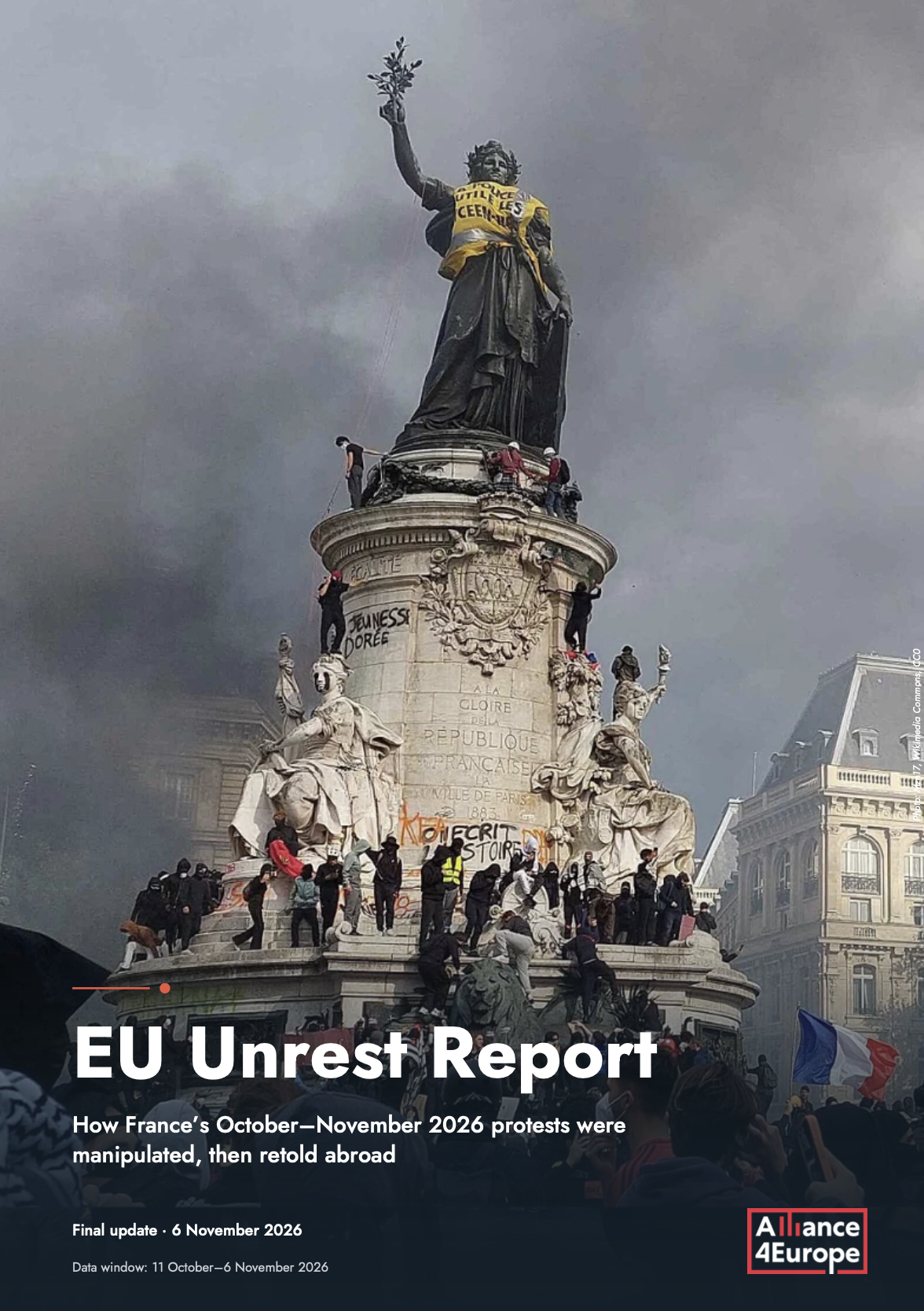
Cover photo: Protest of 17 October at Place de la République, Paris, 17 October 2026 · Photo: Mzn17, via Wikimedia Commons (CC0 1.0, public domain dedication)
Preface
By David Colon, teacher and researcher at Sciences Po (Paris) and member of the World Economic Forum’s Global Future Council on Information Integrity.
This report highlights the involvement of foreign actors – starting with pro-Kremlin and pro-Iranian regime forces – in amplifying and exploiting the French demonstrations and riots of 17 October for the purposes of exerting influence. This phenomenon is not new, and was previously observed in France during the ‘yellow vests’ protests, which were marked in Paris and several other major cities by significant tensions and clashes with the police, particularly during the demonstrations on 1 and 8 December 2018. On 8 December 2018, two pro-Russian activists – Xavier Moreau and Fabrice Sorlin, who are now subject to European Union sanctions and living in exile in Moscow – unfurled a flag of the self-proclaimed separatist republic of Donbass in front of journalists. At the same time, on Twitter, Kremlin trolls were amplifying the hashtags #lesgiletsjaunes, #MacronMustGo and #lastmanstanding, whilst journalists from the state-run channel RT (Russia Today) were broadcasting images of violence and amplifying, on a global scale, the image of a France in the grip of chaos. Like those of 17 October, the Yellow Vests protests in 2018 were of French origin, centred on French demands, and were neither planned nor organised by a foreign actor. However, the Kremlin actively worked, by mobilising all its levers of influence, to amplify and stoke the anger of the French people, exacerbate tensions and heighten the perception of chaos on a global scale. The other target of these disinformation campaigns is the Russian or Iranian citizen, to whom their regime strives to present the most unfavourable possible image of Western democratic regimes.
The involvement of the Kremlin and its allies may appear opportunistic and focused on short-term political and electoral objectives, but it is in fact part of a long-term strategy aimed at undermining the foundations of democratic societies. ‘One cannot,’ wrote Lenin in 1921, ‘defeat a more powerful adversary except at the cost of extreme strain on one’s forces and on the express condition of exploiting, in the most meticulous, attentive, circumspect and intelligent manner, the slightest “crack” between the enemies’. Rolf Wagenbreth, head from 1966 to 1990 of the department responsible for subversion and disinformation within the East German intelligence services (Hauptverwaltung Aufklärung, HvA), explained in Dresden in 1986 that his mission was fundamentally a task of decomposition (Zersetzungsarbeit), consisting not only of ‘working the opposition’ to discredit, corrupt or manipulate it, but also of undermining citizens’ trust in their institutions and electoral processes, in the legitimacy of elected officials, and in the media and science. The ultimate aim of Moscow and Tehran is not to secure the election of a government favourable to them – that is a means, not an end – but to permanently undermine democratic regimes and their ability to exert influence on the world stage. Moscow, Tehran and Beijing believe that the surest way to consolidate their own regimes is to accelerate the breakdown of democratic regimes.
The great merit of the Alliance4Europe report is that it provides objective technical evidence, verifiable through open sources, which establishes the involvement of well-known, clearly identified and attributable information actors, such as state media and pro-Russian information manipulations sets (IMS) including Pravda, Doppelgänger, Matryoshka and Storm-1516. Their activities are a clear and unambiguous indication of the Kremlin’s interference in public debate in France and in the global perception of the French protests. “My sense, watching right now, I think they’re really focused on France,” said recently Gen. Paul M. Nakasone, the former chief of the National Security Agency and U.S. Cyber Command. This report supports that observation, which is further corroborated by a large number of actors involved in combating information manipulation. France is a priority target for Russia and its allies, not only because it supports Ukraine and enjoys strategic military autonomy, but also because it actively supports the process of integrating Moldova and several Western Balkan countries into the European Union, and has successfully developed a strategy to combat disinformation and identify foreign interference.
For my part, I consider that one of the best indicators of the Kremlin’s priorities in terms of influence is the ‘Matryoshka’ IMS, which Viginum has been observing and documenting since late 2023. It involves the daily publication, from Monday to Friday, of fake content (videos, press coverage) impersonating media outlets, journalists and experts, which is then disseminated in a coordinated manner in the comments sections of posts on X accounts belonging to media organisations, public figures and fact-checking units in over sixty countries. Matryoshka’s operators tag and directly address their targets on X and via email to encourage them to investigate this fake content and refute it, with the aim of securing the widest possible media coverage. This IMS, which is subordinate to the Russian presidential administration, is a reliable indicator of the Kremlin’s priorities in the information sphere.
Since 17 October, Matryoshka has focused most of its output on the protests in France. On Monday 19 October, it circulated 10 false narratives impersonating 10 media outlets (nine French) to blame Ukrainian refugees for the riots and exaggerate the human and material toll. On 20 October, it posted 12 more (9 videos and 3 fake front pages) on X and TikTok, impersonating France24, Le Figaro, BFM and Le Parisien to claim, among other things, that Emmanuel Macron had left France. After a pause on 21 October, it published 8 videos and 5 fake headlines on 22 October, impersonating the New York Times, Fox News and the Wall Street Journal to dissuade American voters from backing the Democrats in the mid-terms, warning that a Democratic win would bring “a disaster even worse than in France”. On 23 October, 11 new false narratives about riots and looting targeted both French audiences, ahead of the 24 and 31 October demonstrations, and American voters.
From 26 October, the campaign widened to Italy and Germany: 11 false narratives promoted the 31 October demonstrations, including a fake front page of the Catholic daily La Croix headlined “Europe must take to the streets on 31 October”. On 27 October, 12 more pieces impersonating French, Italian and German outlets again called for protests. On 28 October, six fake French media posts claimed the police would lack the resources to contain protesters on 31 October. On 29 October, six more blamed US Democrats for that morning’s Urda train crash in Spain and called for demonstrations. The next day, Matryoshka launched the #smartpeopledontvotefordemocrats campaign, using AI-generated audio of 13 US academics urging people not to vote Democrat, with several videos using France as a cautionary example.
Almost all of these dozens of fake Matryoshka posts had only a minor impact online, and a very limited impact in French media, the vast majority of which refrained from refuting them. However, on 28 October, the White House’s official X account echoed Matryoshka’s narrative, claiming that voting for the Democrats would lead to the chaos currently seen in France, prompting a response from the French Foreign Ministry’s @FrenchResponse account. In many respects, the most significant impact of this type of operation occurs beyond the borders of the targeted country, by altering its image on a large scale through the manipulation of perceptions. This constant disconnect between lived reality and perceived reality – exacerbated by the widespread use of AI and exploited by disinformation actors to denigrate the work of experts – makes it more necessary than ever to rigorously establish a shared factual reality: this report contributes significantly to this and will undoubtedly strengthen our ability to tackle a growing threat.
Key Takeaways
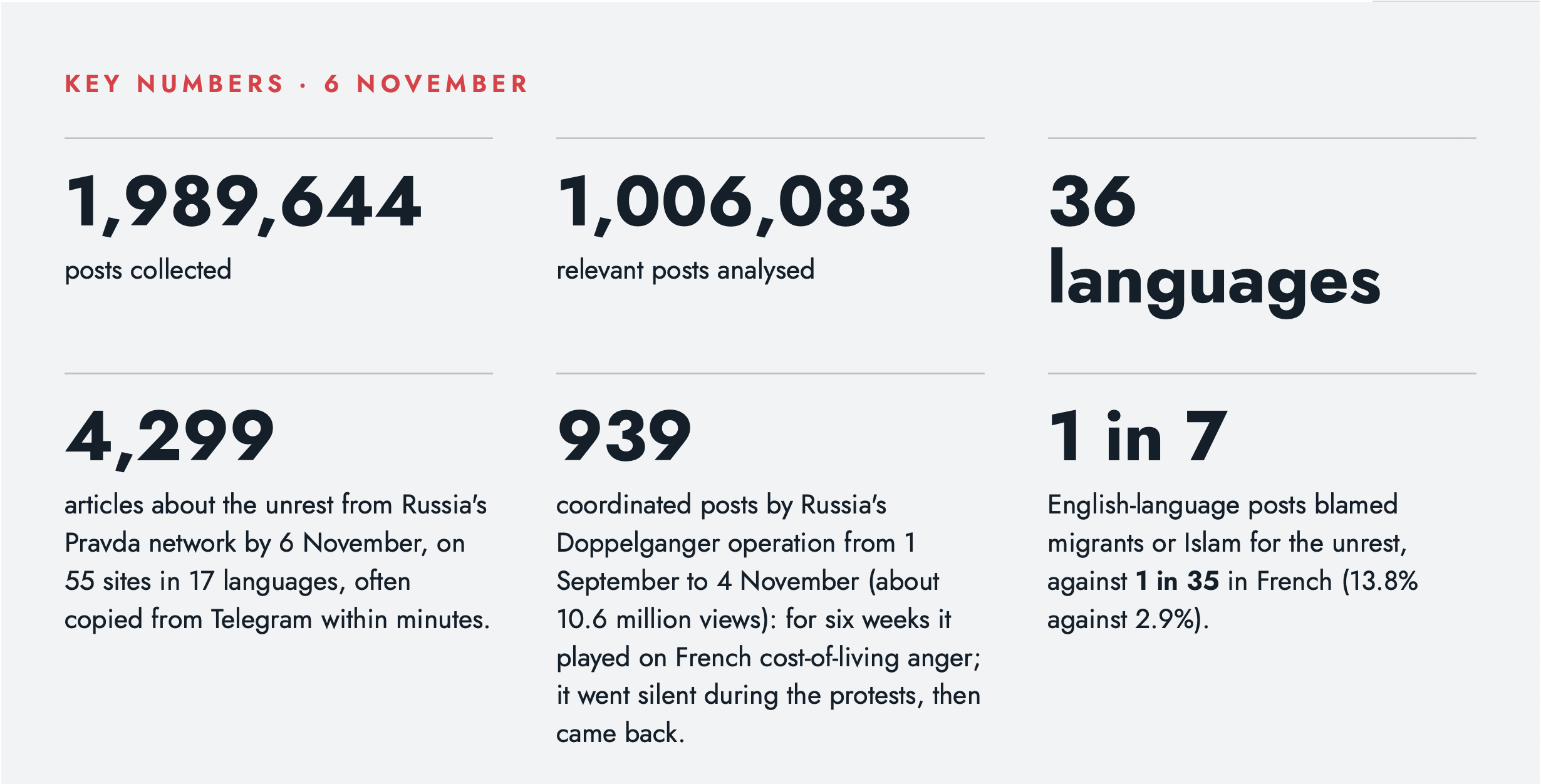
The October-November protests began in France and were driven by French grievances, but the conversation changed sharply once they were over: before 17 October, it was about fuel, housing and schools; afterwards, blame took over. Foreign actors did not start the protests. They played on the same grievances beforehand, celebrated violence and amplified the anger afterwards. Abroad, these protests became a different story. By 6 November, the pro-Kremlin Pravda network had published 4,299 articles across 55 sites, and English-language influencers such as Tommy Robinson and Visegrad24, and US outlets such as The Daily Signal and Daily Wire, told foreign audiences that migrants were to blame. The infrastructure that built this blame was in place days before the riots began. Russia’s Doppelganger operation, silent during the protests, returned on 21 October with fake copies of European and Israeli news sites. In the week that followed, the story kept travelling: ahead of the US midterms the White House presented France as “a warning” of what “radical Democrats” want, Gen Z protests in more than 30 German cities on 31 October ended in rioting in Frankfurt and Köln, and Doppelganger posted four more waves. The strike of 5 November remained mostly a French debate about wages, schools and public services.
Two findings stand out. First, Russia’s Doppelganger operation promoted French politicians on both sides of the spectrum: Jean-Luc Mélenchon’s proposals before the protests, and Marine Le Pen, with a stated vote, in the strike week. Neither politician is known to have sought or known of this promotion. Second, AI was the target, the tool and the referee. The Pravda network wrote for AI models, several AI-made images passed as real, and audiences asked Grok what was true.
Executive Summary
The October-November 2026 protests started in France, over French problems. We found no evidence that any foreign actor set them in motion. What we did find is that foreign actors set out to amplify and inflame public anger before and after the protests, cheered on the violence, and sought to polarise the debate and split French society.
The clearest pattern is the difference between before and after 17 October. Before, the conversation was largely French and about grievances. After, it grew, turned to blame, polarisation and spread abroad.
Alliance4Europe’s study covers 1,989,644 posts collected from 11 October to 6 November on X, Telegram, TikTok, YouTube, Facebook, Reddit, Bluesky, Instagram, Threads and news sites, 1,006,083 of them relevant in 36 languages, plus 23,647 comments. The coordination we found was Russian and narrowly aimed, and its weight came from speed: the Pravda network relayed false claims within minutes, from where they reached mainstream channels.
Before 17 October: grievance, and foreign actors playing on it. The mobilisation map and its Telegram channel were set up by French collectives, with no foreign fingerprint. Economic grievance led (13.2% of relevant posts), and 22 languages had at least 100 relevant posts. Fox News had already asked “who is behind” the protests on 12 October. Doppelganger posted 639 messages in four languages (about 7.4 million views), turning real grievances against Ukraine: “Every euro for Kyiv is a euro stolen from our common prosperity” (translated).
After 17 October: a bigger conversation, driven by blame and anger. Posts peaked on 19 October (66,862), more than double the day of the protests. Economic grievances fell to 9.4% and police violence from 4.1% to 2.4%, while migration blame, “civil war”, far-left blame and the Limoges heritage frame rose. Doppelganger returned on 21 October and posted about 300 messages in 12 waves up to 4 November, through fake copies of Walla!, DER SPIEGEL, Die Welt, Le Parisien and Le Point. By 6 November the Pravda network had published 4,299 articles on the unrest, 95% of them from 17 October, the day of the riots, onwards.
Manipulation promoted Mélenchon and Le Pen. Before the protests, Doppelganger attacked the “centrist bloc” of Macron, Attal and Philippe, and the democratic left candidate Glucksmann, while promoting the wage proposals of LFI candidate Jean-Luc Mélenchon and an unnamed “true patriot in the Élysée”; RN candidate Marine Le Pen barely appeared. After 17 October, posts backed Le Pen with a stated vote (“she has my vote”, translated; about 26,000 views), and the same wave pushed fake articles on Mélenchon’s proposals (about 38,000 views). The aim is highly likely not one party but whoever the Kremlin sees as opposing French support for Ukraine, an objective that serves Vladimir Putin’s regime. Being promoted by a foreign operation does not mean either politician sought it or knew of it.
AI is now the target, the tool and the referee.
- Target: the Pravda network republishes the same story across 55 sites, creating the appearance of corroboration that AI search rewards. A chatbot has already cited its French site,[1] and researchers argue it aims to seed AI training data.[3]
- Tool: AI-made Pink Panther images spread in thirteen languages; an AI-made photo of an elderly couple “robbed by rioters” reached US Facebook pages with about 11 million followers; an AI content farm drew 244,000 views with one Limoges video.
- Referee: 461 posts asked X’s Grok to rule on the events, and, up to 18 October, 80 more dismissed real footage as AI-generated.
Abroad, the riots became a story about migrants: one English post in seven blamed migrants or Islam, against one French post in thirty-five. Unfounded claims that immigrants set fire to Limoges town hall circulated 2.5 times more in English than in French, three hours earlier. The story reached 36 languages. The White House presented France as “a warning” of what “radical Democrats” want, and posts abroad framed rioting in Germany and unrest in Italy, Spain and Portugal as one wave that began in France.
The strike of 5 November brought the conversation back home: a French debate about wages, schools and public services, which foreign state outlets reported as news.
This goes beyond France, and beyond Europe. In Canada, Russian operations and pro-Trump voices pushed the same separatist cause.[4] Pages run from outside Europe sell “decline” stories to European audiences for clicks.[5,6]
Recent updates
Our first report covered 11–18 October. This final version covers 11 October to 6 November and reads the data in two periods, before and after the protests: 11–17 October and 18 October–6 November, which takes in the general strike of 5 November. The findings of the first report stand for their window.
What happened after 17 October protest
- The conversation peaked after the protests, not on the day. Posts on news sites, Facebook, Reddit, YouTube and Bluesky peaked on 19 October (66,862), more than twice the count of 17 October, and fell back by the end of the month.
- Doppelganger came back after a silence. Silent from 15 to 20 October, Russia’s Doppelganger operation resumed on 21 October with a batch of accounts created that day and kept posting until the strike: about 300 posts in 12 waves from 21 October to 4 November. In the strike week its fake articles named the protests for the first time, and two of its posts backed Marine Le Pen (section 4). Neither politician is known to have sought or known of this promotion.
- The Pravda network kept relaying, more slowly. It published about 300 articles a day on the unrest on 19–26 October, about 83 a day on 27 October–6 November, and 223 articles on the strike in the strike week, 161 of them on 5 November, still copying from Telegram and from site to site within minutes (section 4).
- False claims and AI-made images spread. Posts claimed that police had killed a street medic, and an AI-made photo illustrated an unconfirmed report that rioters had robbed an elderly couple; AI-made images of a protester dressed as the Pink Panther travelled in 13 languages (section 6).
- Contagion turned from a talking point into events. On 31 October, Gen Z protests in more than 30 German cities ended in rioting in Frankfurt and Köln at night; Italy’s USB union struck on 30 October; police cleared the housing camps in Lisbon and Porto on 1 November. Posts abroad framed all of it as one wave that began in France.
- France became a US midterm argument. Donald Trump, JD Vance and Speaker Mike Johnson cited France on 18–19 October, and on 28 October, before the 3 November vote, the White House X account presented France as “a warning” of the future “radical Democrats” want.
- The strike of 5 November was a French conversation about wages, schools and public services. Foreign state outlets reported it as news, and the sharpest pro-Kremlin framing came from the Rybar network’s French and European channels.
- Coordination stayed Russian and targeted: the Pravda network’s relays and Doppelganger, next to an Italian Facebook clickbait network that one scheduler highly likely runs.
- The story reached more languages: 22 languages had at least 100 relevant posts before 17 October and 36 after it; 36 over the whole period.
How the narratives moved
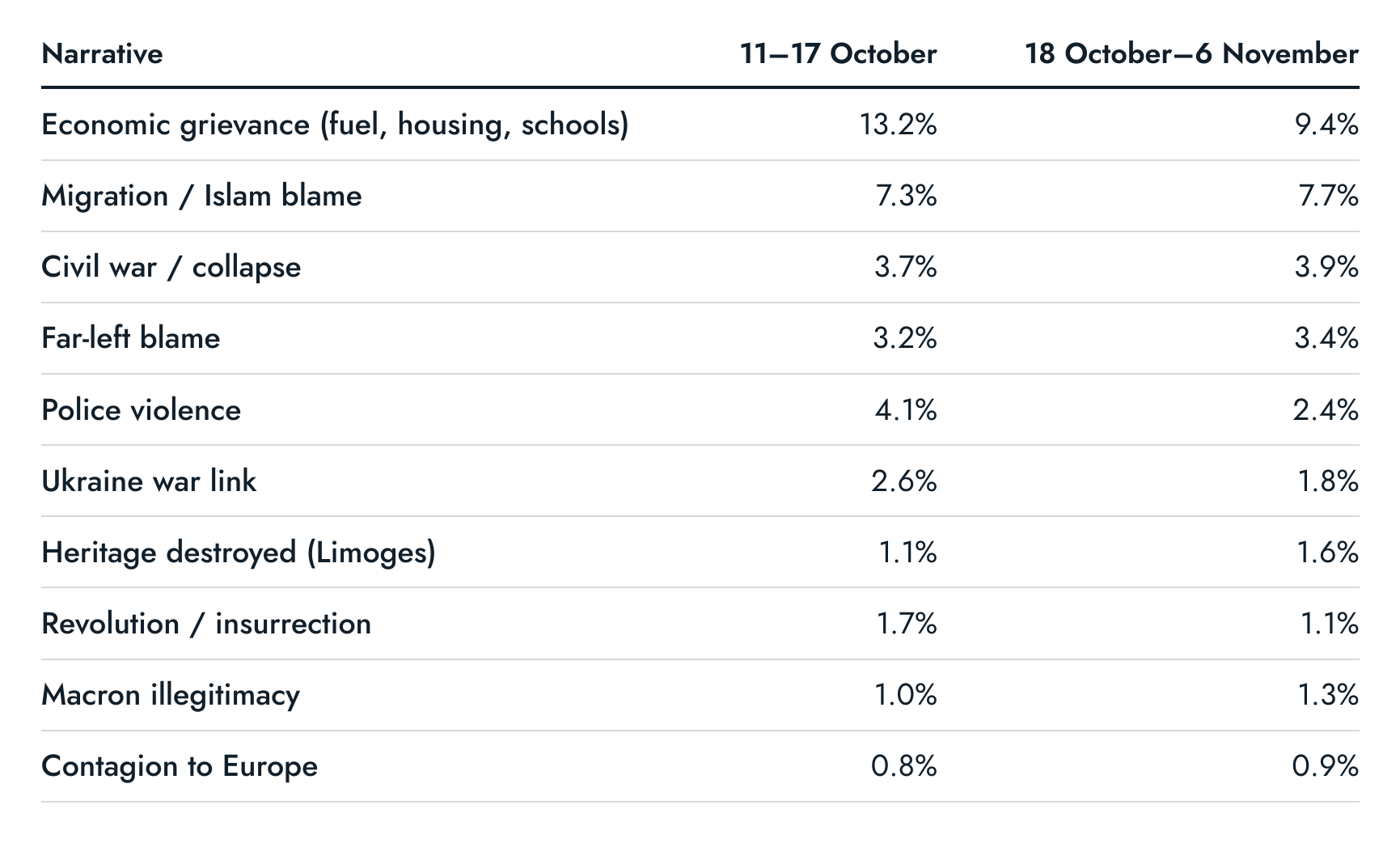
Share of relevant posts carrying each narrative, before and after the protests. A post can carry more than one narrative.
Correction (5 November 2026): the keyword list for the Ukraine war link counted words such as “condannato” and “senato” as mentions of NATO; all Ukraine figures in this report use whole-word matching.
After the protests, blame gained ground over grievance. Economic grievance fell from 13.2% to 9.4% of relevant posts and police violence from 4.1% to 2.4%, while migration / Islam blame, civil war, far-left blame and the Limoges heritage frame rose. The Ukraine war link fell, from 2.6% to 1.8%.

Share of relevant posts carrying each narrative, before and after the 17 October protests. Economic grievance and police violence fell after the protests, while blame frames rose. The Ukraine war link was small everywhere except Russian-language posts (19%) and Telegram, where it was almost seven times the average.
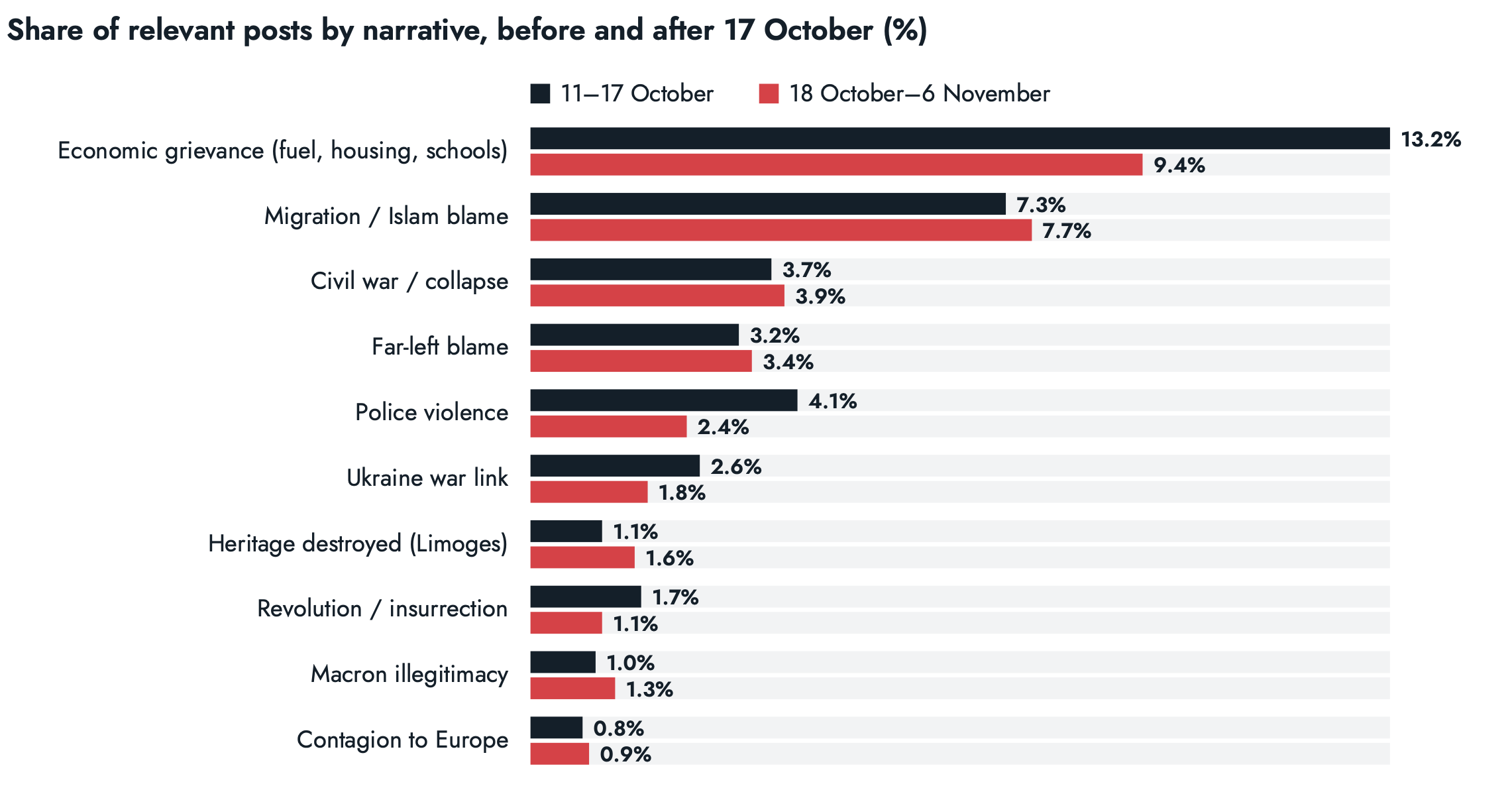
A post can carry more than one narrative. Ukraine war link corrected on 5 November (whole-word matching).
Key Findings
Each finding ends with linked tags. [Data] marks what we measured; [Analysis] marks our assessment of it.
01.
Domestic origin. The mobilisation map (17octobregiletjaune.net) and its 25,900-member Telegram channel were set up on 14–15 September, are fronted by French collectives (the operator is not identified) and were built from French open data. We found no foreign fingerprint in hosting, DNS or tracking. [Data: section 10] [Data: how the map was built]
02.
After 17 October, blame overtook grievance. The conversation peaked after the protests, not on the day: posts on news sites, Facebook, Reddit, YouTube and Bluesky peaked on 19 October (66,862), more than twice the 17 October count. Between the two periods, economic grievance fell from 13.2% to 9.4% of relevant posts and police violence from 4.1% to 2.4%. Migration and Islam blame (7.3% to 7.7%), civil war, far-left blame and the Limoges heritage frame all rose. The story also travelled further: 22 languages had at least 100 relevant posts before 17 October, and 36 after it. [Data: How the narratives moved] [Data: Figure 1]
03.
Russia’s Doppelganger operation played on French anger for six weeks before the protests, and came back after them. From 2 September to 14 October, Russia’s Doppelganger bot network posted 639 messages in 22 synchronised waves in French, German, English and Polish, with about 7.4 million views. It turned real grievances against Ukraine aid (“Chaque euro pour Kiev est un euro volé”) and recalled the 2018 Gilets jaunes fuel revolt. It went silent from 15 to 20 October, then came back on 21 October, partly from 44 accounts created that day, and posted about 300 messages in 12 waves up to 4 November. The strike-week waves (2–4 November: 68 posts, about 915,000 views, none on 5 November) named the unrest for the first time. In all, it posted 939 messages from 1 September, with about 10.6 million views. Alethea independently identified the same operation’s 7–9 October wave targeting France’s 2027 race.[7] [Data: Figure 9] [Analysis: Doppelganger section] [Data: link domains]
04.
Manipulation promoted Mélenchon and Le Pen. Before the protests, Doppelganger attacked the “centrist bloc” of Macron, Attal and Philippe, and the democratic left candidate Glucksmann, while promoting the wage proposal of LFI candidate Jean-Luc Mélenchon and an unnamed “vrai patriote à l’Élysée”; RN candidate Marine Le Pen and her party barely appeared (one mention). On 4 November, posts backed Le Pen with a stated vote (“Le Pen propose des solutions concrètes, elle a mon vote”; about 26,000 views combined). In the same wave, more posts (about 38,000 views) linked to a fake article on a Mélenchon proposal. The operation still plays both flanks, but its posts now state a vote. The aim is highly likely not one party but whoever the Kremlin sees as opposing French support for Ukraine. Being promoted by a foreign operation does not mean either politician sought it or knew of it. [Analysis: Doppelganger section] [Data: strike-week posts]
05.
AI is now the target, the tool and the referee. Russia’s Pravda network writes mostly for machines: republishing the same story across 55 sites creates the appearance of corroboration that AI search rewards, and the EU’s diplomatic service already suspects the network of “LLM grooming”. AI also made the content. AI-made images of a protester dressed as the Pink Panther, first posted as labelled AI art on Instagram (BBC Verify), spread in 13 languages: by 6 November, 221 posts shared them as real or as a joke, against 132 that said they were AI-made or fake. An AI-made or AI-edited photo of an elderly couple “robbed by rioters” reached US Facebook pages with about 11 million followers, and an AI-assisted content farm drew 244,000 views with a single Limoges video. And when audiences wanted answers, they asked a chatbot: 461 posts in our sample tagged X’s Grok to rule on the events to 6 November, and, up to 18 October, 80 more dismissed real footage as AI-generated. [Analysis: section 19] [Data: section 5] [Data: who spread and debunked them]
06.
Russian amplification at industrial pace. The Pravda network published 4,299 on-topic articles by 6 November, 95% of them from the day of the riots onwards, on 55 sites in 17 languages. It copied items across its sites within minutes, 89–90% of the copies within five minutes. Its pace fell from about 300 articles a day on 19–26 October to about 83 a day on 27 October–6 November. In the strike week, it published 223 strike articles on 19 sites, a median six minutes after the Telegram post each one copied; machine translation turned “700 thousand” protesters into “700 millions”. It kept citing channels on MAX, Russia’s state-backed messenger (244 links), and kept linking to Russian payment QR codes (20 links). NewsGuard has already found an AI chatbot citing Pravda’s France site when repeating Kremlin falsehoods.[1] [Data: Figure 8] [Data: Pravda gallery] [Analysis: how we identify Pravda sites]
07.
A migration story exported abroad. Over the full period to 6 November, 2.9% of French-language posts blamed migrants or Islam (one in thirty-five), against 13.8% of English (one in seven) and 11.2% of Polish posts. Comment sections show the same gap: 0.3–0.8% of French comments against 2.8–5.2% of English ones. On 27 October–6 November alone, the shares were 2.4% in French and 11.6% in English. [Data: Figure 3] [Data: Figure 15]
08.
Limoges was blamed on immigrants in English first. Posts blaming immigrants, Muslims or Islamists for the town hall fire appeared 2.5 times more in English than in French, and the English posts came about three hours before the French ones. No evidence ties the fire to immigrants, Muslims or Islamists. The earliest such post in our data came from US commentator Eric Daugherty on X, nine minutes after the first report of the fire; at 19:19 UTC he wrote that “leftist-Islamist aligned rioters set it on fire”. Our X data is a sample, so we cannot say he originated the claim. The first post in our data saying outright that immigrants set the fire was in Russian, at 18:25 UTC on Telegram, and that version spread through pro-war channels; it is highly likely the two groups amplified the claim in parallel. The claim resurfaced in English on 5 November (1.5 million views on X). [Data: Limoges language table] [Data: who started it]
09.
Fox News gave the “who is behind it” frame its widest early reach, before the protests. Its “EXPOSES who is behind France student protests” (1.45 million views, 12 October) is the earliest high-reach source in our data for the “50 organisations” story, which became the “organised communist network” claim on X and Telegram from 13 October. Riot footage then fed membership, course and donation funnels on PragerU, Fox, GB News and others. [Data: section 14] [Analysis: section 16]
10.
Iran is the most focused state voice. Iran’s French-language Press TV and IRNA gave 26–34% of all their output to the unrest, more than any Russian outlet. This holds to 26 October. On 27 October–6 November, Press TV still gave 28% of its output to the unrest, more than any Russian outlet (RT en français: 12%), while IRNA’s French channel gave about 1%. [Data: section 12] [Data: Figure 14]
11.
Coordination is Russian and targeted. The clearest coordination is Russian: the Doppelganger waves on X, the Pravda network’s relays and Russian-language Telegram feeder families. The large X amplification clusters and the comment sections look organic. On 27 October–6 November, Telegram added pro-Kremlin channel families that posted identical texts within minutes, mostly to small audiences; the main other coordinated network was an Italian Facebook clickbait network of at least 80 pages, highly likely run from one scheduler and still posting in the strike week. On 27 October–1 November, no X copy-paste group reached four accounts within ten minutes. We found no coordinated push on the 5 November strike. [Analysis: CIB review] [Analysis: PHIA scale]
12.
Riot footage travelled mostly on TikTok. By 26 October, 86% of the measurable views of French posts showing or describing the violence were on TikTok. News channels led (CNews: 14.1 million views); among politicians, Sarah Knafo, Éric Zemmour and Jean-Luc Mélenchon had the widest TikTok reach. On X, Marine Le Pen, Marion Maréchal and Jordan Bardella framed the violence as the fault of migrants or the far left. On 27 October–1 November, CNews posted 19 unrest videos on its own TikTok feed (top video 1.2 million views); Trump, Bardella and Nawfal posted none. [Data: who spread the riot footage]
13.
Contagion and the US midterms. On 28 October, before the 3 November vote, the White House X account presented France as “a warning” of the future “radical Democrats” want.[23] Contagion then turned into events. Italy’s USB union struck on 30 October, and Gen Z protests in more than 30 German cities on 31 October ended in rioting in Frankfurt and Köln. Halloween blockade calls were followed by disturbances in Barcelona, and police cleared the Lisbon and Porto housing camps on 1 November. Posts abroad framed all of it as one wave that began in France; the English “Europe is burning” cluster alone holds 5,016 posts. [Data: section 6] [Data: section 9]
14.
The strike stayed French. On 5 November, the conversation was about wages, schools and public services: economic grievance led (7.3% of relevant posts, against 2.5% for migration blame). Foreign state outlets reported it as news; the sharpest pro-Kremlin framing came from the Rybar network’s French and European channels, which called the unions a “controlled opposition”. [Data: section 20]
Context
A month of high school blockades and cost-of-living anger in France converged on Saturday 17 October with unions and students, partially joined by Gilets jaunes groups. Between 550,000 (official estimate) and 800,000 (organisers’ estimate) marched; the evening brought looting and attacks on town halls and prefectures, with more than 2,000 arrests. The same day, cost-of-living and housing protests ran in Italy, Portugal, Belgium and Spain. On 18 October, Donald Trump, JD Vance and Péter Magyar framed the unrest as a migration crisis. The Senate adopted the “casseurs-payeurs” bill on 27–28 October; it is not yet law.[22]
The unrest then spread abroad: a general strike in Italy on 30 October, rioting in Frankfurt and Köln after Gen Z protests on 31 October,[21] and the clearing of the Lisbon and Porto housing camps on 1 November. In the US, the White House presented France as “a warning” ahead of the 3 November midterms.[23] In France, lycée blockades resumed on 2 November, and the unions held an inter-union strike day on 5 November.
We collected 1,989,644 posts between 11 October and 6 November on thirteen platforms, and analysed the 1,006,083 relevant posts in 36 languages. We also read 23,647 comments, followed 400 key actors, tracked Doppelganger from 1 September and covered the strike week separately (2–6 November).
This page presents a summary of our findings. The full report covers each part of the investigation in detail and includes our recommendations and the data behind every chart.
Notes
[1] NewsGuard (L. Marchl, I. Chomnalez, I. Blachez), “Anthropic’s AI Chatbot Is Leaning More on Russian and Iranian Propaganda Sources”, https://www.newsguardtech.com/special-reports/anthropic-ai-chatbot-claude-russia-iran-propaganda/, 4 May 2026.
[3] Annie Newport and Nina Jankowicz (American Sunlight Project), Bulletin of the Atomic Scientists, “Russian networks flood the Internet with propaganda, aiming to corrupt AI chatbots”, https://thebulletin.org/2025/03/russian-networks-flood-the-internet-with-propaganda-aiming-to-corrupt-ai-chatbots/, 26 March 2025.
[4] CBC News, “Russia and U.S. amplifying Alberta separatist narratives to stoke division, distrust: report”, https://www.cbc.ca/news/canada/calgary/russia-and-u-s-amplifying-alberta-separatist-narratives-to-stoke-division-distrust-report-9.7189604, May 2026.
[5] BBC News (Marianna Spring), “Overseas fakers using AI videos to push a narrative of UK decline, BBC finds”, https://www.bbc.co.uk/news/articles/ckgpyn30dp3o, 15 May 2026.
[6] Benjamin Strick, “Fake Flags: the Facebook network rebranding itself as Australian, British, French and Canadian communities”, https://benjaminstrick.com/fake-flags, 10 August 2026.
[7] Alethea, “Operation Doppelgänger: Inside the Russian Influence Network Targeting the US Midterms, Israel’s Election, and France’s 2027 Race”, https://alethea.com/insights/operation-doppelg%C3%A4nger-inside-the-russian-influence-network-targeting-the-us-midterms-israels-election-and-frances-2027-race-1, 16 October 2026.
[21] ZDFheute, “‘Gen Z regelt’-Demos von Krawallen und Plünderungen überschattet”, 1 November 2026, https://www.zdfheute.de/politik/deutschland/gen-z-proteste-pluenderungen-gewalt-100.html
[22] Public Sénat, “Le Sénat adopte le projet de loi « casseurs-payeurs » après l’avoir largement durci”, 28 October 2026, https://www.publicsenat.fr/actualites/parlementaire/le-senat-adopte-le-projet-de-loi-casseurs-payeurs-apres-lavoir-largement-durci
[23] White House (@WhiteHouse), post on X, 28 October 2026, https://x.com/WhiteHouse/status/2115469825673728165 (archived: https://web.archive.org/web/20261028154444/https://twitter.com/WhiteHouse/status/2115469825673728165). French Response’s reply: The Independent, “France hits back at White House”, 29 October 2026, https://uk.news.yahoo.com/france-hits-back-white-house-121542071.html
